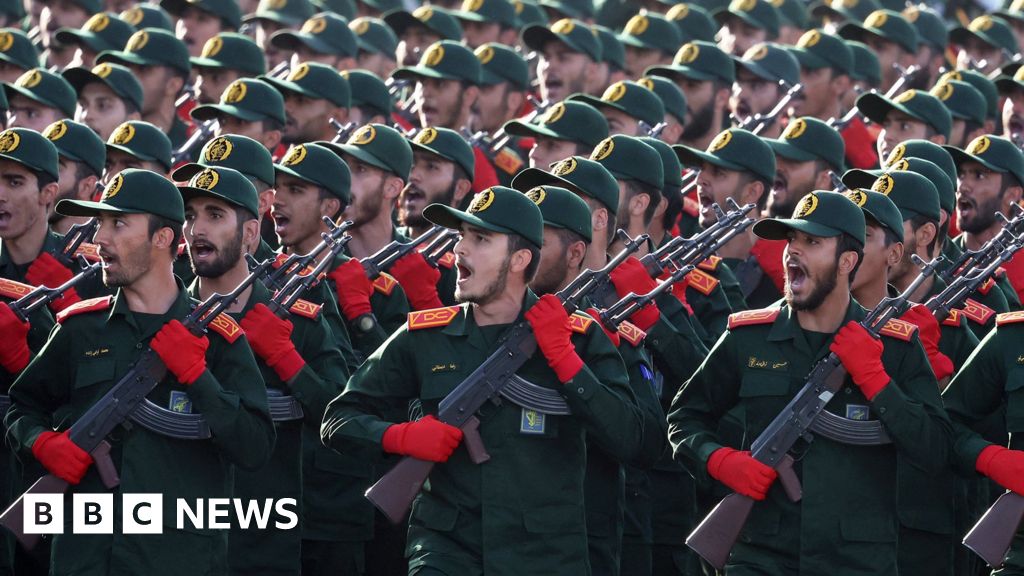
The EU's Stance: Designating Iran's Revolutionary Guard a Terrorist Organization
The European Union's recent decision to officially classify Iran's Islamic Revolutionary Guard Corps (IRGC) as a terrorist organization marks a pivotal moment in international relations with Tehran. This bold move, a culmination of mounting pressure and grave concerns over human rights, solidifies the notion often discussed as 'garde révolutionnaire terroriste' – a terrorist revolutionary guard – into official EU policy. Far from a mere symbolic gesture, this designation carries significant weight, aiming to curb the regime's repressive tactics at home and its destabilizing influence abroad. But what precisely led to this landmark decision, and what are its broader implications for Iran, the EU, and global security?
The EU's Landmark Decision: Why Now?
The impetus behind the European Union's classification of the IRGC on its list of terrorist organizations is rooted in the corps' egregious actions, particularly its brutal crackdown on widespread protests across Iran. These demonstrations, ignited by the tragic death of Mahsa Amini in September 2022, rapidly evolved into the "Woman, Life, Freedom" movement, challenging the very foundations of the Islamic Republic.
For months, human rights organizations have accused the IRGC, the ideological army of the Iranian regime, of orchestrating a bloody and deadly repression of these protests. The scale of the violence has been staggering, with reports from the Iranian Interior Ministry and various NGOs indicating thousands of deaths and countless arrests. The EU's top diplomat, Kaja Kallas, confirmed that the decision was a direct response to this "insupportable repression of the peaceful revolt of the Iranian people."
While the European Parliament had previously urged the 27 member states to place the Pasdaran (another term for the IRGC) on its black list in 2023, the recent wave of repression finally galvanized key European players. Nations like France, Germany, Italy, and Spain openly supported the measure, signaling a united front against Tehran's authoritarian rule. This designation significantly escalates the pressure on the Iranian regime, beyond existing sanctions, by criminalizing any form of material support or engagement with the IRGC.
The Islamic Revolutionary Guard Corps: A Force of Repression and Influence
To understand the gravity of the EU's decision, one must grasp the profound role and nature of the Islamic Revolutionary Guard Corps within Iran. Established in the aftermath of the 1979 revolution, the IRGC was envisioned as a parallel military force, distinct from the conventional army, with the primary mission of protecting the Islamic Revolution and its values. Unlike a traditional national army, its loyalty is directly to the Supreme Leader, Ayatollah Ali Khamenei, rather than to the state's political institutions.
Over the decades, the IRGC has evolved into a vast and powerful entity, encompassing not only ground, naval, and air forces but also intelligence, economic, and cultural branches. It wields immense influence across Iranian society, controlling significant sectors of the economy through a network of foundations and companies. Domestically, the Basij, a paramilitary volunteer militia under IRGC command, is instrumental in enforcing social and religious norms and, crucially, in suppressing dissent. It is this internal repression, characterized by its extreme brutality against peaceful demonstrators, that formed the core justification for the EU's classification.
Beyond Iran's borders, the IRGC's Quds Force is a critical instrument for projecting Iranian power and influence across the Middle East. It provides training, funding, and arms to a network of proxy groups, from Hezbollah in Lebanon to various militias in Iraq, Syria, and Yemen. This external dimension has led to accusations of destabilizing regional security and, as noted in the reference context, engaging in a multiplication of attacks globally over the past three years. The EU's move, therefore, addresses both the internal repression and the external threats posed by this formidable organization.
International Implications and Iran's Response
The EU's decision to brand the IRGC as a terrorist organization immediately triggered a sharp reaction from Tehran. In a predictable act of diplomatic defiance, Iran announced it had summoned European ambassadors stationed in Tehran. According to Iranian Foreign Ministry spokesman Esmaïl Baghaï, representatives from all EU member states with an embassy in the capital were called in to receive Tehran's strong condemnation of the move.
Baghaï labeled the summoning a "minimal measure," hinting at further retaliatory actions to come. Such threats underscore the significant diplomatic fallout and potential for escalation that accompany the EU's designation. While the exact nature of Iran's "reprisals" remains to be seen, they could range from expelling diplomats, curtailing nuclear inspections, or even more aggressive actions in the region, potentially impacting shipping or proxy conflicts.
From an international policy perspective, this designation is far from symbolic. It carries concrete legal implications, including the freezing of IRGC assets within EU jurisdictions, travel bans for its members, and the criminalization of providing any financial or material support to the organization. This makes it significantly harder for the IRGC to operate internationally and for EU entities to engage, even indirectly, with businesses or individuals linked to the corps. It also sends a clear message to other nations about the EU's unequivocal stance against state-sponsored terrorism and human rights abuses.
Conclusion
The European Union's designation of Iran's Islamic Revolutionary Guard Corps as a terrorist organization marks a significant hardening of its policy towards Tehran. Driven by the IRGC's brutal repression of the "Woman, Life, and Freedom" movement and its broader record of destabilizing activities, the decision reflects a growing international consensus that the corps operates as a direct threat to peace and human rights. While Iran has predictably reacted with defiance and threats of retaliation, the EU's move carries substantial legal and financial weight, aiming to curtail the IRGC's capabilities and hold the regime accountable. This development undoubtedly opens a new, more confrontational chapter in EU-Iran relations, with potential ramifications for regional stability and the future of dissent within Iran itself.